


Kaiser Permanente ‘mystery caller’ survey asked California cannabis employees how they would advise a pregnant customer
Pregnant people may be getting inaccurate information about the risks of cannabis use in pregnancy from employees at California cannabis retailers, research from Kaiser Permanente has found. The study was published Dec. 10 in JAMA Network Open.
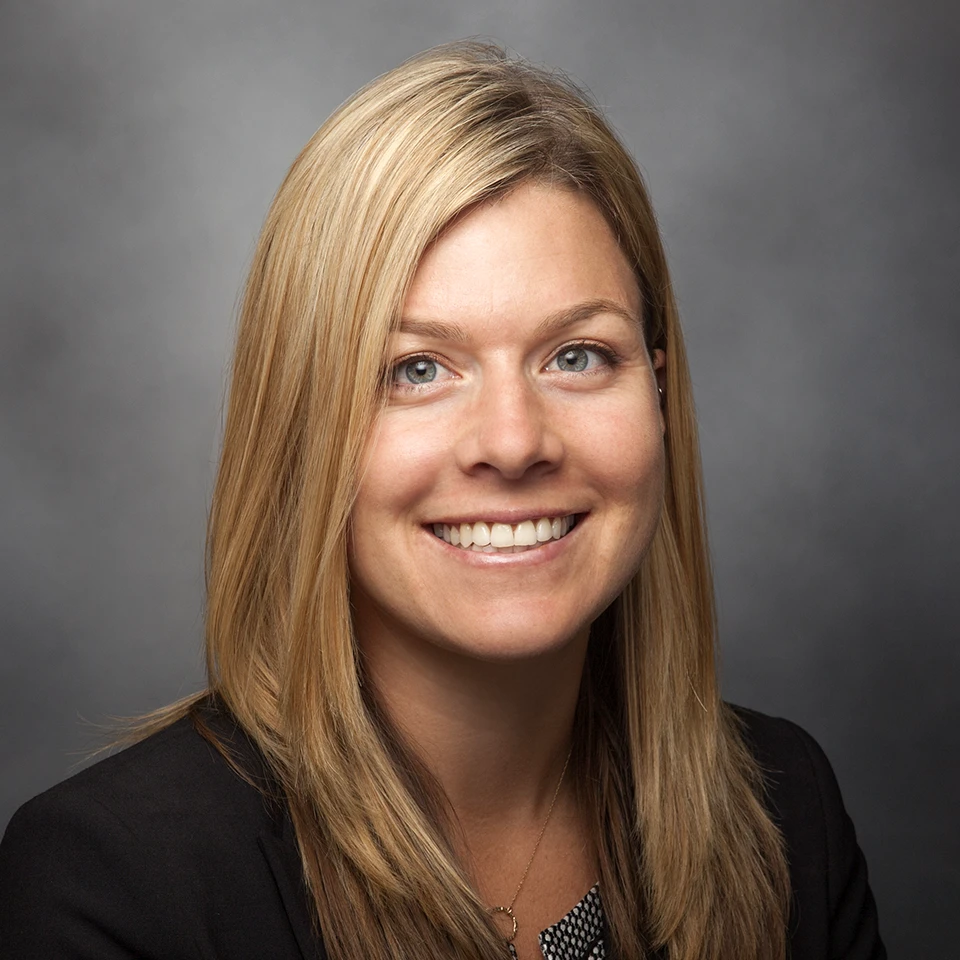
Previous research has shown cannabis use in pregnancy is harmful to both the pregnant person and the fetus. But this information may not be reaching young people, said Kelly Young-Wolff, PhD, MPH, the study’s lead author and a licensed clinical psychologist and research scientist at the Kaiser Permanente Northern California Division of Research (DOR).
Pregnant people in a recent focus group organized by Young-Wolff’s research team said they used cannabis for conditions like morning sickness because they thought it was safer, she said. “Misinformation around the safety of prenatal cannabis use is concerning,” she added. “National medical guidelines recommend against using cannabis during pregnancy due to potential health risks, but many pregnant individuals perceive cannabis to be safe.”
The researchers chose to interview cannabis store employees, known as “budtenders,” because their research indicated that pregnant people saw them as a trusted, nonjudgmental source of information, Young-Wolff said.
The study involved a telephone survey of 505 cannabis retailers, with the caller posing as a pregnant person wanting to know whether tobacco, cannabis, and blunt (a combination of tobacco and cannabis) use is safe in pregnancy. One-fifth (20.6%) told the caller that prenatal cannabis use is safe, while two-fifths (40%) said it was unsafe.
The respondents were more likely to advise callers to avoid use of tobacco-containing products than those with cannabis, suggesting the retailers are more aware of health concerns about tobacco than cannabis.
“Most retailers were familiar with the health risks of tobacco — both in general and during pregnancy — and did not hesitate when recommending the caller reduce or stop blunt use,” noted co-author Monique Does, MPH, a senior research project manager with DOR. “Whereas conversations around cannabis were more variable and less directive.”

More pregnant people are using cannabis — and using it daily — since recreational use of cannabis was legalized in California, Young-Wolff noted. Also, cannabis products being marketed in California are stronger now than in the past.
Study design and findings
For the study, 3 members of the research team, including Young-Wolff, posed as pregnant people. They made telephone calls to 505 randomly selected licensed California storefront cannabis retailers between February 2024 and January 2025 and spoke with one employee at each. The researchers used two scripts, one mentioning using cannabis for mental health purposes, and the other without mention of mental health.
In the survey responses, 79.6% of respondents said prenatal blunt use is unsafe in pregnancy and 79.2% said prenatal tobacco use is unsafe. Less than 1% said either exposure was safe.
But the message budtenders gave on cannabis was different. Just 40.4% said prenatal cannabis use was unsafe, and 20.6% said it was safe.
Asked about forms of cannabis, 31.7% said edibles are safer than other modes in pregnancy. Little research exists comparing relative risks of various modes of prenatal cannabis use.
In California, cannabis products are required to include a warning that use during pregnancy may be harmful; however, only 5.7% of budtenders referenced these warnings during conversations. Encouragingly, the vast majority (90%) recommended that callers speak with a health care provider about cannabis use in pregnancy, with 44% doing so spontaneously and an additional 46.1% making this recommendation when asked directly whether the caller should consult their doctor.
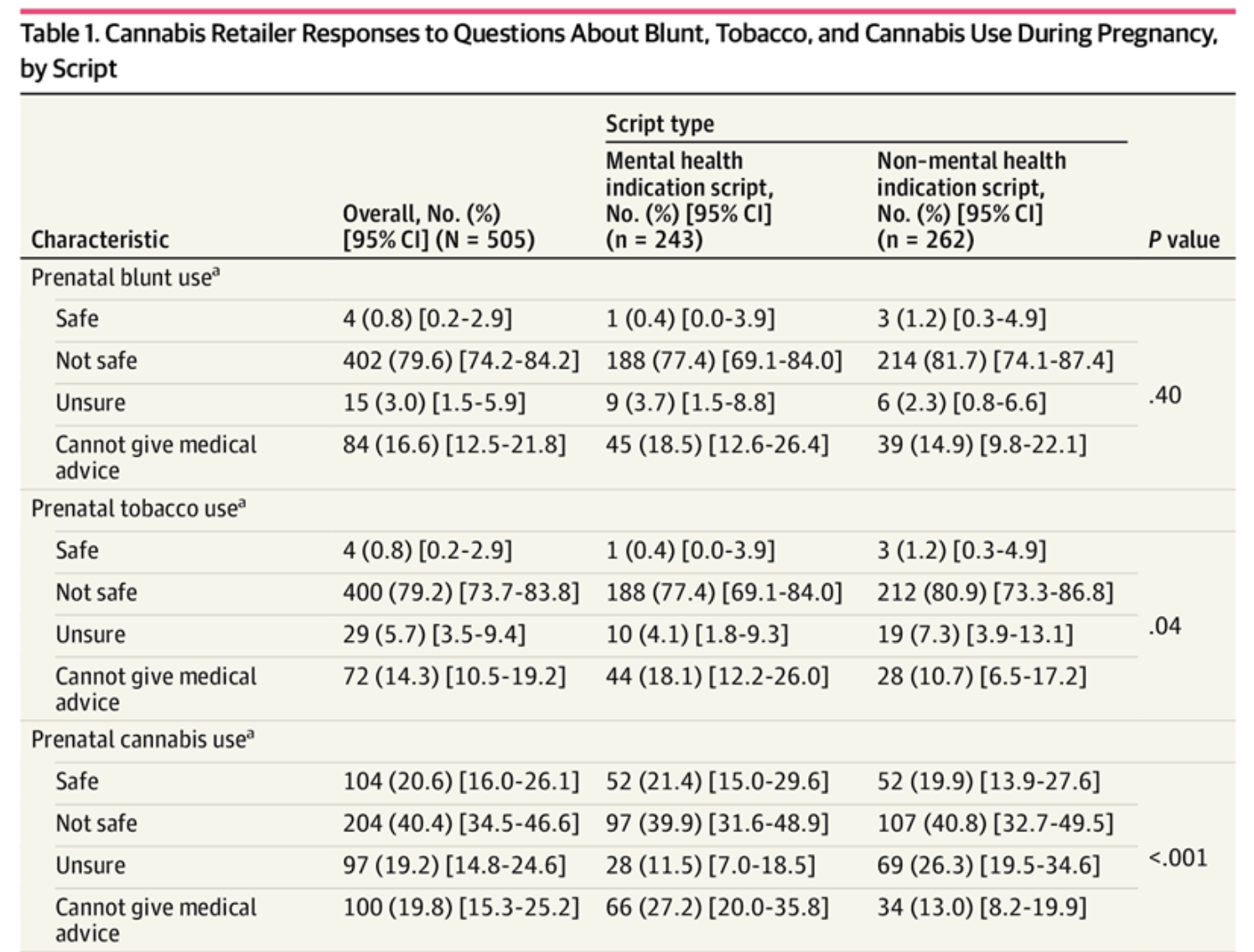
When a caller mentioned seeking use for a mental health purpose, budtenders were more cautious. They were more than twice as likely to state they could not say whether cannabis is safe during pregnancy (27% vs. 13%), and much less likely to say they were not sure (11.5% vs. 26%). They were also nearly twice as likely to recommend low- or no-THC products (49% vs. 25%).
Young-Wolff noted that, consistent with patients’ reports, budtenders were generally supportive, nonjudgmental, and caring in their interactions with pregnant individuals. “They genuinely wanted to provide helpful guidance,” she explained, “but they didn’t always have accurate information to draw from.”
In working with patients, the study team has found many look to budtenders as a key source of information. “They view budtenders as being similar to doctors and really valued their perspective and advice about which products to use,” said Does. “We wanted to hear what cannabis retailers are recommending to pregnant people who call in saying that they’re using cannabis.”
Applying the findings
California requires no medical training to be a budtender. The researchers hope their work helps pregnant people understand the limits of budtenders’ knowledge and demonstrates the need to educate retail cannabis workers on the risks of cannabis use in pregnancy.
Previous Kaiser Permanente research has found pregnant people using cannabis welcome information from their health care providers about its possible harms. New training for budtenders could help them learn “to direct pregnant people to their physicians or midwives for a discussion of the risks of cannabis use in pregnancy, which would also allow the clinicians to discuss other therapies for any symptoms that the patient may be experiencing,” said Torri Metz, MD, MS, the paper’s senior author and a physician at University of Utah Health.

A California law was approved after the study survey calls were completed that requires cannabis retailers to prominently display a warning brochure on the health risks of cannabis use and offer a hard copy to customers after their first purchase. Research is needed to determine whether this is effective or more needs to be done, the study authors said.
“We need warnings that people will remember, written in a way that resonates better with people, so that the warnings are not just disregarded,” added Young-Wolff.
This study was supported by Kaiser Permanente Northern California Community Health.
Additional co-authors were Rahel Negusse, BA, Shannon N. Ogden, PhD, MPH, and Joshua R. Nugent, PhD, of the Division of Research; and Lynn D. Silver, MD, MPH, and Aurash J. Soroosh, RD, MSPH, of the Prevention Policy Group Public Health Institute.
###
About the Kaiser Permanente Division of Research
The Kaiser Permanente Division of Research conducts, publishes, and disseminates epidemiologic and health services research to improve the health and medical care of Kaiser Permanente members and society at large. KPDOR seeks to understand the determinants of illness and well-being and to improve the quality and cost-effectiveness of health care. Currently, DOR’s 720-plus staff, including 73 research and staff scientists, are working on nearly 630 epidemiological and health services research projects. For more information, visit divisionofresearch.kp.org or follow us @KPDOR.




Comments (0)