


Study finds low rate of in-person follow-up needed for 4 common outpatient conditions
Many patients seeking care for common outpatient conditions selected a simple online e-visit rather than talking to a doctor in-person, by phone, or by video, according to a Kaiser Permanente analysis published in JAMA Network Open.

The study also found that Kaiser Permanente Northern California (KPNC) members who chose electronic visits had low rates of follow-up care in the following 7 days, comparable to follow-up rates of other types of visits.
The findings support the rapid expansion of e-visits in an integrated health care system for patients to get convenient medical care round the clock for a growing number of straightforward health complaints, the authors said.
“Electronic visits are popular with patients, particularly those in their 20s and 30s, though these types of visits are used robustly by all age groups up to 65,” said senior author Mary E. Reed, DrPH, a research scientist with the Kaiser Permanente Division of Research. “It’s good to find out that the need for follow-up care is similar to other types of visits.”
The KPNC e-visit can be initiated anytime through the health system’s online portal. When choosing an e-visit, the member is led through a series of questions; the answers are reviewed by a health care professional and the member receives a response by secure message within 4 hours, and usually sooner. The response may involve medical advice, a prescription for medication, a recommendation to follow-up with a medical visit or to call a specialized advice line, such as the international travel clinic.

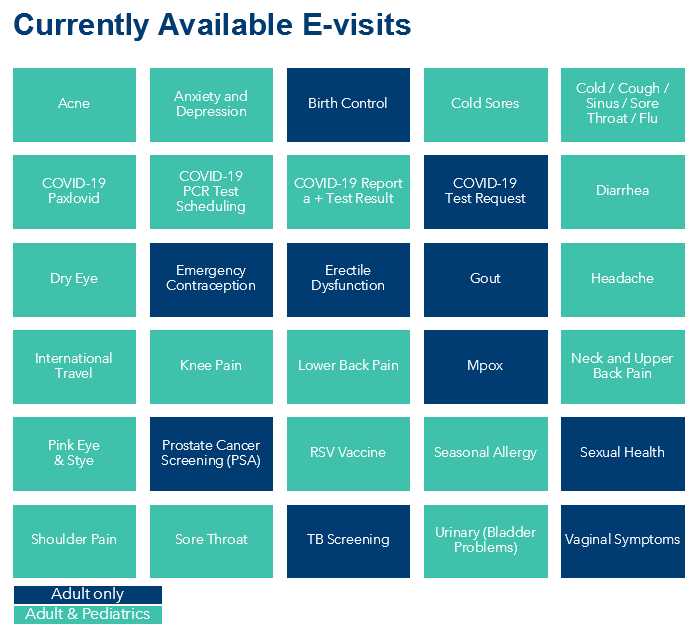
E-visits are currently available for about 30 health concerns for KPNC patients, and new e-visits are being added regularly, said co-author Khai Tran, MD, medical director for the KPNC Virtual Care Program. “It’s a great, convenient, safe choice for most patients,” he said. “We want our patients to choose the optimal type of visit to deliver safe, high-quality care.”
For many health issues patients can choose one of several options for care: an e-visit, a phone or video call with a doctor, or an in-person visit.
The study analyzed visits during 2024 for 4 common health issues: urinary tract infection, seasonal allergy, acne, and international travel. E-visits were chosen by 58% of patients with urinary tract infections, 56% of patients seeking advice in advance of international travel, 24% of patients with seasonal allergy symptoms, and 24% of patients with acne.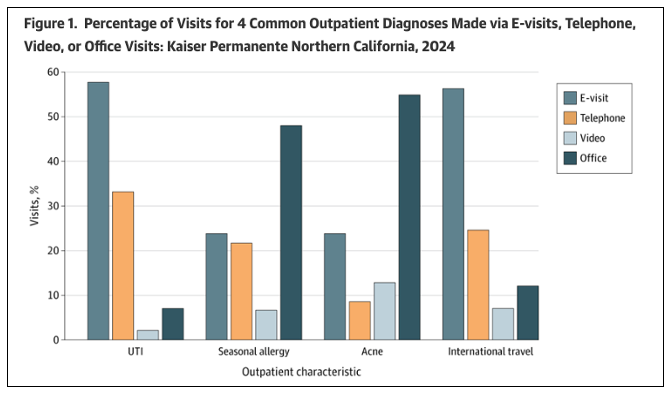
The researchers compared the “point of contact resolution” (POCR) rate — how often a patient’s health care need was resolved during the visit — and found e-visits to have high rates of POCR, the authors said. The POCR rates for e-visits were similar to or better than other visit formats for 3 of the 4 conditions studied.
That doesn’t necessarily mean e-visits were more effective than phone, video, or in-person visits; those with less acute symptoms might have been more likely to choose the online option.
The rates of follow-up care within the 7 days of an e-visit were 2.5% for urinary tract infection, 2.1% for acne, 6.5% for seasonal allergy, and 0.1% for international travel.
The analysis found e-visit use for the 4 selected conditions to be strong across all ages, races and ethnicities, language spoken, and comorbidities. Socioeconomic status was not associated with more or less e-visit use. E-visit use was higher among patients who had previously used an e-visit and those who use the health system’s mobile portal.
Continuous development and quality enhancement
The Virtual Care team tracks metrics closely on rates of follow-up emails and calls after visits, to determine if improvements to the process can be made, said co-author Dao Nguyen, MD, medical director of the KPNC International Travel Clinic. The team is also tracking patients’ care experience with the format.

The e-visit questionnaires and algorithms are regularly reviewed and updated to make improvements and adjustments to follow evolving medical guidelines. For example, the cough, cold, and flu e-visit will now include a question about whether the patient has taken a home test for flu, with an option for a prescription for Tamiflu if they qualify. “That will be a really nice option for patients this year,” Tran said.
Meanwhile, the Virtual Care program is regularly developing new e-visit types, with more than a dozen in the pipeline. “Our team thinks about what topics would lend themselves to being developed into an e-visit, and we are regularly approached by our colleagues in primary and specialty care with ideas for new topics,” Tran said.
 Nguyen noted that the growing set of e-visit options are gaining users, but patients should know that they can always seek out a different type of visit. “If you need something higher acuity, our physicians are there to support you,” he said.
KPNC strategizes carefully to target the right health topics and scope for an e-visit, said Kristine Lee, MD, associate executive director of The Permanente Medical Group. “It is very important that we are not adding another touch point with a patient without resolving their concern,” Lee said. “Our goals include ensuring the appropriate utilization of health care resources and great outcomes for our patients.”
The study is part of larger body work on virtual care led by Reed that includes a 2021 paper in JAMA Network Open that was one of the first analyses looking at health outcomes of e-visits.
The study was funded by The Permanente Medical Group.
The study’s lead author was Tracy Lieu, MD, MPH, and additional co-author was Jie Huang, PhD, both of the Division of Research.
###
About the Kaiser Permanente Division of Research
The Kaiser Permanente Division of Research conducts, publishes, and disseminates epidemiologic and health services research to improve the health and medical care of Kaiser Permanente members and society at large. KPDOR seeks to understand the determinants of illness and well-being and to improve the quality and cost-effectiveness of health care. Currently, DOR’s 720-plus staff, including 73 research and staff scientists, are working on nearly 630 epidemiological and health services research projects. For more information, visit divisionofresearch.kp.org or follow us @KPDOR.





Comments (0)