


Kaiser Permanente study finds fast-growing or advanced tumors — not insurance coverage — are behind survival differences between Black and White young women
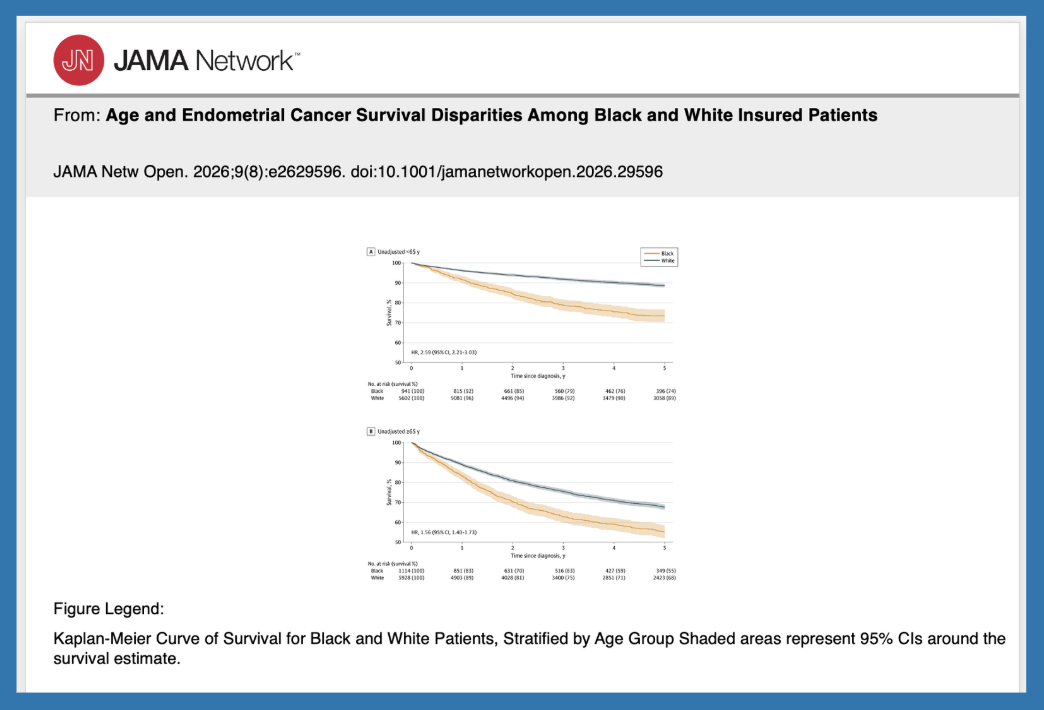
In a Kaiser Permanente study of 13,585 women with uterine cancer, Black patients had worse survival rates than White patients overall, but the racial gap in survival was largest among women under 65 due to pronounced racial imbalances in rates of aggressive and advanced tumors.

The study, published in the journal JAMA Network Open, is the first to show the survival gap between Black and White uterine cancer patients is larger in younger women, and to identify the reasons for the disparity.
“Understanding why this gap exists is the first step toward addressing it,” said lead author Betty Suh-Burgmann, MD, an adjunct investigator with the Kaiser Permanente Division of Research (DOR) and a gynecologic oncologist with The Permanente Medical Group. “We found that the main factor explaining the wider disparity in younger patients is that the increased risk for Black patients to be diagnosed with aggressive type tumors compared to White patients is more pronounced among women under 65.”
In the United States, Black women are nearly twice as likely as White women to die from uterine cancer. In an earlier Kaiser Permanente study, Suh-Burgmann and her team reported that 71.3% of this disparity could be explained by higher rates of aggressive or advanced-stage disease in Black women than in White women. Socioeconomic factors accounted for another 18.9%.
“During that analysis, we noticed the survival gap by race appeared larger for women under 65 than for older women,” Suh-Burgmann said. “It definitely sparked our interest.”
A few prior studies had also noted a larger survival disparity among younger patients, Suh-Burgmann said, but none had looked at why. The only proposed explanation was that younger patients were less likely to have health insurance before age 65 — when Medicare becomes available — than older patients.
“But at Kaiser Permanente, everyone is insured and has access to the same care, meaning insurance coverage could not be the culprit,” Suh-Burgmann said. “So, we decided to do an additional analysis to investigate.”
Whereas older Black women were twice as likely to be diagnosed with aggressive type tumors than older White women, younger Black women were three times more likely to be diagnosed with these tumors compared to their White counterparts.
— Betty Suh-Burgmann, MD
The researchers analyzed electronic health record data from 2,055 Black and 11,530 White members of Kaiser Permanente Northern California or Kaiser Permanente Southern California, who were diagnosed with uterine cancer between 2005 and 2022. About half were under 65 years old. The analysis showed the survival disparity between Black and White women was 43% wider among patients under 65 compared to older patients.
 Next, the research team applied additional statistical tools to determine how much of the difference between older and younger patients could be explained by each of several factors: tumor type, patient demographics, speed of diagnosis, treatment, socioeconomic factors, and having additional health issues.
“Whereas older Black women were twice as likely to be diagnosed with aggressive type tumors than older White women, younger Black women were three times more likely to be diagnosed with these tumors compared to their White counterparts,” Suh-Burgmann said.
The other factors the researchers included in their analyses did not contribute significantly to the survival disparity difference. “Overall, our findings refute the notion that insurance explains the bigger survival gap in young patients,” Suh-Burgmann said.
Better treatments, smaller gap
Why are Black women at higher risk of worse types of uterine tumors than White women, and why is this risk more pronounced in younger women?

“Nobody knows the answer,” Suh-Burgmann said. “So far, no significant difference has been found in genes known to predispose to cancer. It’s possible that there may be environmental exposures involved, such as pesticides and other toxins. It’s also possible that there may be genes involved that affect susceptibility to environmental exposures and indirectly influence cancer risk.”
For now, Suh-Burgmann said, improved treatments may already be helping. Data suggest the survival gap between Black and White uterine cancer patients has narrowed in recent years, perhaps due to advancements in chemotherapies, targeted therapies, and immunotherapies, used to treat more aggressive tumors. As treatments improve, the hope is the gap will become smaller.
“Our analysis highlights how important it was to follow up on our initial findings,” said senior author Julie Schmittdiel, PhD, associate director of Health Care Delivery and Policy and a DOR research scientist. “It really shows the need for more research to not only identify why younger Black women are developing these more aggressive tumors but to determine how to provide care that is tailored to this younger population.”
The study was funded by The Kaiser Permanente Garfield Memorial Fund.
Co-authors include Holly Finertie, MPH, at the Division of Research; and Haoyuan Zhong, MS, and Claudia Nau, PhD, of the Department of Research & Evaluation, Kaiser Permanente Southern California.
###
About the Kaiser Permanente Division of Research
The Kaiser Permanente Division of Research conducts, publishes, and disseminates epidemiologic and health services research to improve the health and medical care of Kaiser Permanente members and society at large. KPDOR seeks to understand the determinants of illness and well-being and to improve the quality and cost-effectiveness of health care. Currently, DOR’s 720-plus staff, including 73 research and staff scientists, are working on nearly 630 epidemiological and health services research projects. For more information, visit divisionofresearch.kp.org.






Comments (0)