

Kaiser Permanente study finds simple, automated patient portal, email messaging, or texts helps patients stay on their medication
Sending digital reminders to adults who were not consistently refilling their statin prescriptions significantly increased their reorder rates, a new Kaiser Permanente study found.

The study was presented at the European Society of Cardiology Congress 2026 and published simultaneously in JAMA.
Statins — medications used to treat people with high cholesterol, type 2 diabetes, and other heart problems — are prescribed to millions of people in the U.S. By lowering cholesterol levels, these drugs also reduce the risk of heart disease, heart attack, and stroke. Yet many people who are prescribed these daily medications do not consistently refill their prescriptions.
“Statins are very effective in lowering cardiovascular risk,” said lead author Ankeet Bhatt, MD, MBA, ScM, a research scientist at the Kaiser Permanente Division of Research (DOR) and a cardiologist with The Permanente Medical Group. “However, adherence to this treatment is suboptimal nationally. Finding strategies that help people not miss refilling these potentially life-saving medicines was our motivation for this work, and we were pleased to see that we found a strategy that was successful.”
Study design and findings
The study included 20,604 members of Kaiser Permanente Northern California who had been diagnosed with atherosclerotic cardiovascular disease (ASCVD) — meaning they had cholesterol deposits, called plaque, in their arteries — or had type 2 diabetes, which increases the risk for ASCVD. All the patients in the study had low adherence, filling their daily statin medication less than 80% of the time in the prior 12 months.
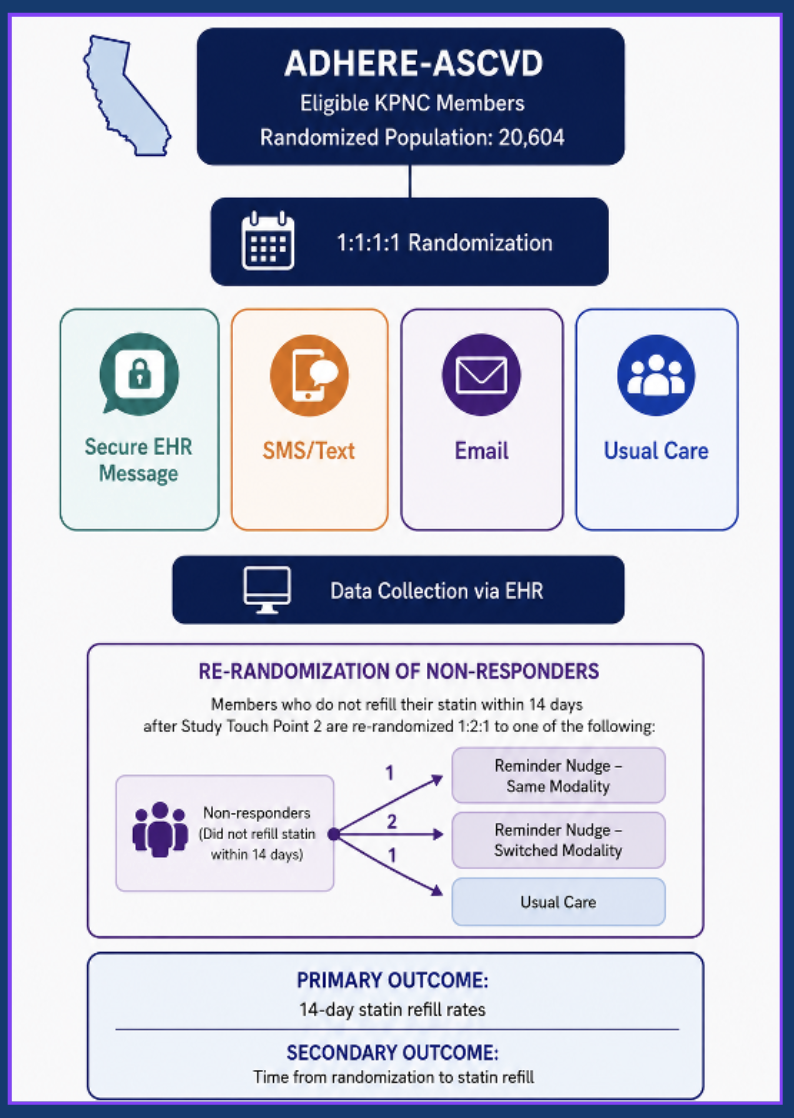 Kaiser Permanente pharmacies routinely send patients a reminder when it is time to refill their medications. For the study, the researchers divided the patients into 4 groups: one group was sent only the standard pharmacy communication. The other 3 groups were sent the standard pharmacy communication and a new communication sent by one of 3 methods — a text message, a secure email message through a patient portal, or a nonsecure email message. The new communication reminded them it was time to refill their statin, explained why it was important to take their medication regularly, and provided instructions on how to refill the prescription.
The research team found that, overall, patients who received the new reminders had a 20% higher relative likelihood of refilling their statin prescription within 14 days compared with those who received only the standard pharmacy reminder. Specifically, 14.4% of the patients who received the new reminder refilled their prescription compared with 12% of those who received only the standard pharmacy reminder, an absolute improvement of 2.4 percentage points.
“We were very pleased to see that this digital health strategy, which was low touch and highly scalable across our health system, was successful in this challenging-to-reach population,” Bhatt said.

The research team also tested the impact repeating the reminder would have. They sent a second reminder — either by the original method or a new method — to 75% of the patients who had not refilled their prescription within 14 days of the first reminder. The second reminder further increased refill rates, with the patients who received the second reminder having a 25% higher relative likelihood of refilling their prescription. Specifically, 13% of patients sent the second reminder refilled their prescriptions compared with 10.4% of those who did not, an absolute improvement of 2.6 percentage points.
“This study tested simple, low-effort ways of increasing adherence, and it showed us that it is the number of reminders, rather than the reminder’s method, that is the biggest predictor for people refilling their prescriptions,” said Douglas Corley, MD, PhD, chief research officer at The Permanente Medical Group and a DOR research scientist. “This means we now have a strategy we can implement to help our patients increase their use of statins and help them ward off heart disease.”
Next steps in digital outreach research
The research team plans to further analyze data from the study to learn whether some methods worked better for different groups of people based on gender, race, type 2 diabetes status, and consistency in taking statins in the past. “We also intend to use the study model and operational collaboration to look at whether digital outreach can improve health in other ways,” said Bhatt.
Added Corley: “Evidence-based care, such as statins for decreasing heart attacks and strokes, only works if people use it. This trial took us a crucial step forward in understanding which approaches work and which don’t, and it lays the groundwork for similar pragmatic trials across Kaiser Permanente.”
The study was funded by The Permanente Medical Group.
Co-authors include Vincent X. Liu, MD, MS, Baiyang Sun, PhD, Mirasol Apostol-Largeteau, MPH, Ben J. Marafino, PhD, Mariam Amiri, BS, Duc (Lilly) Tran, BS, Andrew P. Ambrosy, MD, MPH, and Alan S. Go, MD, from the Division of Research; clinicians and operational teams from Kaiser Permanente Northern California and the School of Medicine; and investigators from Stanford University School of Medicine, Copenhagen University Hospital, and Harvard Medical School, on behalf of the ADHERE-ASCVD Investigators.
###
About the Kaiser Permanente Division of Research
The Kaiser Permanente Division of Research conducts, publishes, and disseminates epidemiologic and health services research to improve the health and medical care of Kaiser Permanente members and society at large. KPDOR seeks to understand the determinants of illness and well-being and to improve the quality and cost-effectiveness of health care. Currently, DOR’s 720-plus staff, including 73 research and staff scientists, are working on nearly 630 epidemiological and health services research projects. For more information, visit divisionofresearch.kp.org.





Comments (0)