


Kaiser Permanente leader contributes to nationwide Veterans Affairs study
Patients with metastatic castration-resistant prostate cancer that did not progress when previously treated with the chemotherapy drug docetaxel may have better survival if they choose docetaxel again when they need a new treatment regimen rather than switch to the chemotherapy drug cabazitaxel, a new study published in JAMA Network Open suggests.

“The findings highlight a clinically important option for patients who are often faced with multiple treatment decisions,” said co-author Rachel Ramoni, DMD, ScD, director of the Kaiser Permanente Division of Research. Ramoni co-authored the study while serving as chief research and development officer at the U.S. Department of Veterans Affairs.
Prostate cancer is the second leading cause of cancer deaths in the U.S. Dozens of cancer therapies are now approved for treating early-stage and metastatic prostate cancer. As more treatments have become available, it has become more difficult for researchers to conduct randomized trials that compare existing therapies while accounting for patients’ prior treatents.
Docetaxel is a type of taxane chemotherapy. It has been a standard treatment for metastatic castration-resistant prostate cancer since 2004. (Castration-resistant refers to a tumor that continues to grow after hormone therapies have greatly reduced the patient’s level of testosterone.) Cabazitaxel, a different type of taxane, was approved in 2010 for use in patients with metastatic castration-resistant prostate cancer who had been treated with docetaxel previously. Both drugs work by stopping cancer cells from dividing.
Real-world data analyses
To date, no clinical trials have compared the effectiveness of a second round of docetaxel with switching to cabazitaxel in patients with metastatic castration-resistant prostate cancer whose cancers did not progress when they were initially treated with docetaxel, and the researchers said such trials are unlikely to occur.
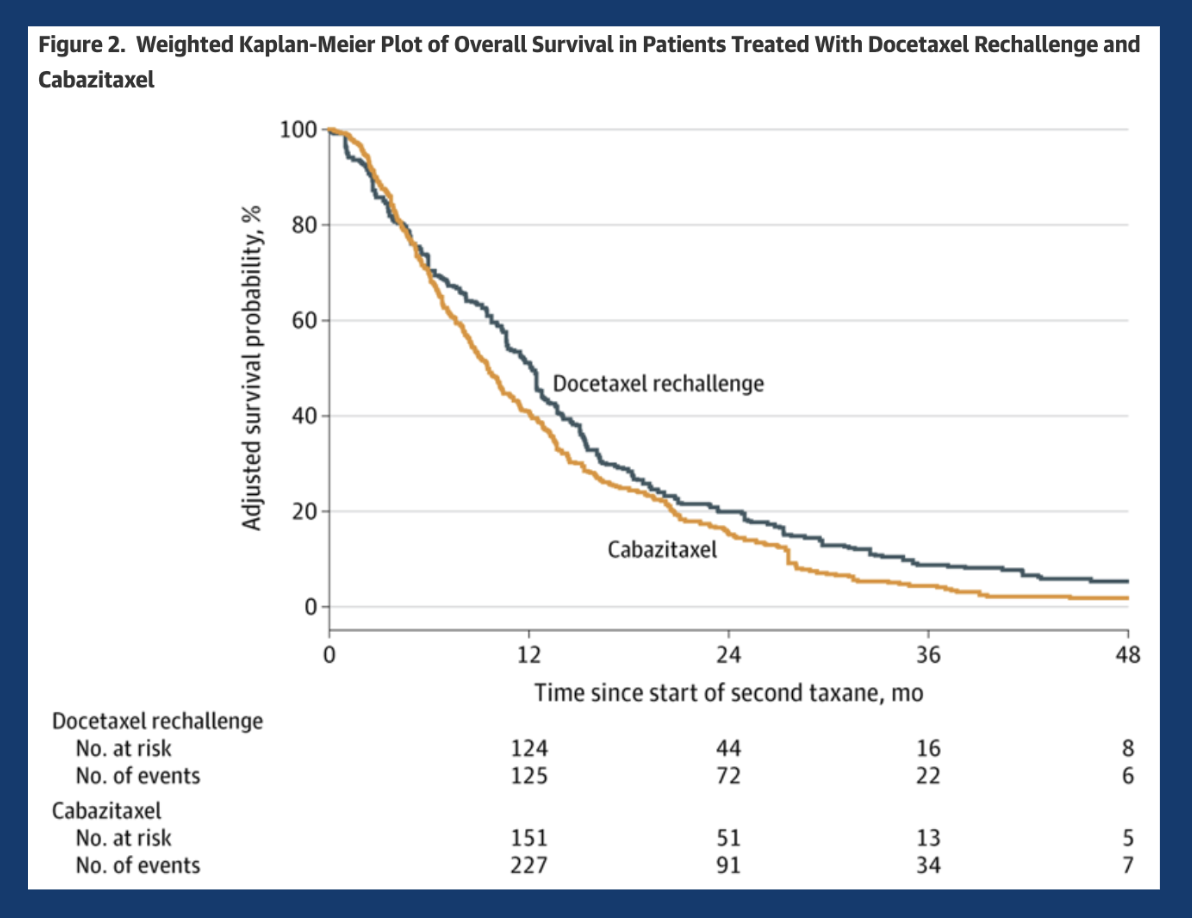 To fill that research gap, the study team combed through data in the VA’s electronic health records and used complex statistical analyses to compare survival differences between 407 patients whose second taxane treatment was cabazitaxel and 262 patients who received docetaxel for the second time.
The analyses showed that patients who received docetaxel had a median overall survival from the start of their second taxane of 12.3 months compared to 9.6 months for those on cabazitaxel, a statistically significant difference. The study also found patients receiving docetaxel had fewer supportive‑care needs.
“This study shows that the high-quality real-world data that exists inside our patients’ electronic health records contains information that can be analyzed to fill research gaps and guide treatment choices,” said Ramoni.
Veterans Affairs, like Kaiser Permanente, is an integrated health care system. Ramoni said the team’s findings are one example of what is possible when clinical care and data science come together at scale in these types of health care systems.
“The health care systems at the VA and Kaiser Permanente create a unique opportunity for investigators with deep research expertise to generate evidence that can has the potential to improve patient outcomes,” said Ramoni. “Both systems are able to use their data to conduct large real-world studies that could be carried out in few other locations.”
The study was supported by the VA Cooperative Studies Program and the VA Office of Research of Development’s Precision Oncology Actively Managed Portfolio through the PROFOUND-VET initiative.
Co-authors include first authors Pedro C. Barata, MD, of University Hospitals Seidman Cancer Center in Cleveland and June K. Corrigan, MS, of the Massachusetts Veterans Epidemiology Research and Information Center in Boston; and senior authors Channing J. Paller, MD, of Johns Hopkins University School of Medicine, and Matthew B. Rettig, MD, of the Greater Los Angeles Veterans Affairs Healthcare System, among others.
###
About the Kaiser Permanente Division of Research
The Kaiser Permanente Division of Research conducts, publishes, and disseminates epidemiologic and health services research to improve the health and medical care of Kaiser Permanente members and society at large. KPDOR seeks to understand the determinants of illness and well-being and to improve the quality and cost-effectiveness of health care. Currently, DOR’s 720-plus staff, including 73 research and staff scientists, are working on nearly 630 epidemiological and health services research projects. For more information, visit divisionofresearch.kp.org or follow us @KPDOR






Comments (0)