


Kaiser Permanente study in Black adults links problems with cognition to small particle pollution
Long-term exposure to fine particle air pollution can affect cognitive function, new Kaiser Permanente research shows.
“Our findings add to a growing body of research that suggests pollution doesn’t only damage the heart and lungs but also affects how the brain functions,” said lead author Stacey E. Alexeeff, PhD, a research scientist and biostatistician at the Kaiser Permanente Northern California Division of Research (DOR).

The study, published in Alzheimer’s & Dementia: Behavior & Socioeconomics of Aging, a journal of the Alzheimer’s Association, is one of the first to examine air pollution exposures over 17 years and its effect on specific types of cognitive function. It included 740 adults ages 53-94 enrolled in the ongoing Kaiser Permanente Study of Healthy Aging in African Americans (STAR). Launched in 2017, the STAR study aims to identify factors that impact healthy brain aging among Black adults.
“Previous studies have found that in the U.S., Black adults have significantly higher rates of dementia than non‑Hispanic White adults have,” said co-author Paola Gilsanz, ScD, a DOR research scientist who is co-leading the STAR study. “It is important to look at reasons for this disparity, and environmental exposures, like air pollution, is one of multiple factors we are exploring.”
Measuring memory
All STAR participants were members of Kaiser Permanente Northern California at the time they enrolled in the study, age 50 or older, identified as Black, lived in the San Francisco Bay Area, and had previously completed a voluntary check between 1964 and 1985 that included health questionnaires and clinical measures called the Multiphasic Health Checkups.

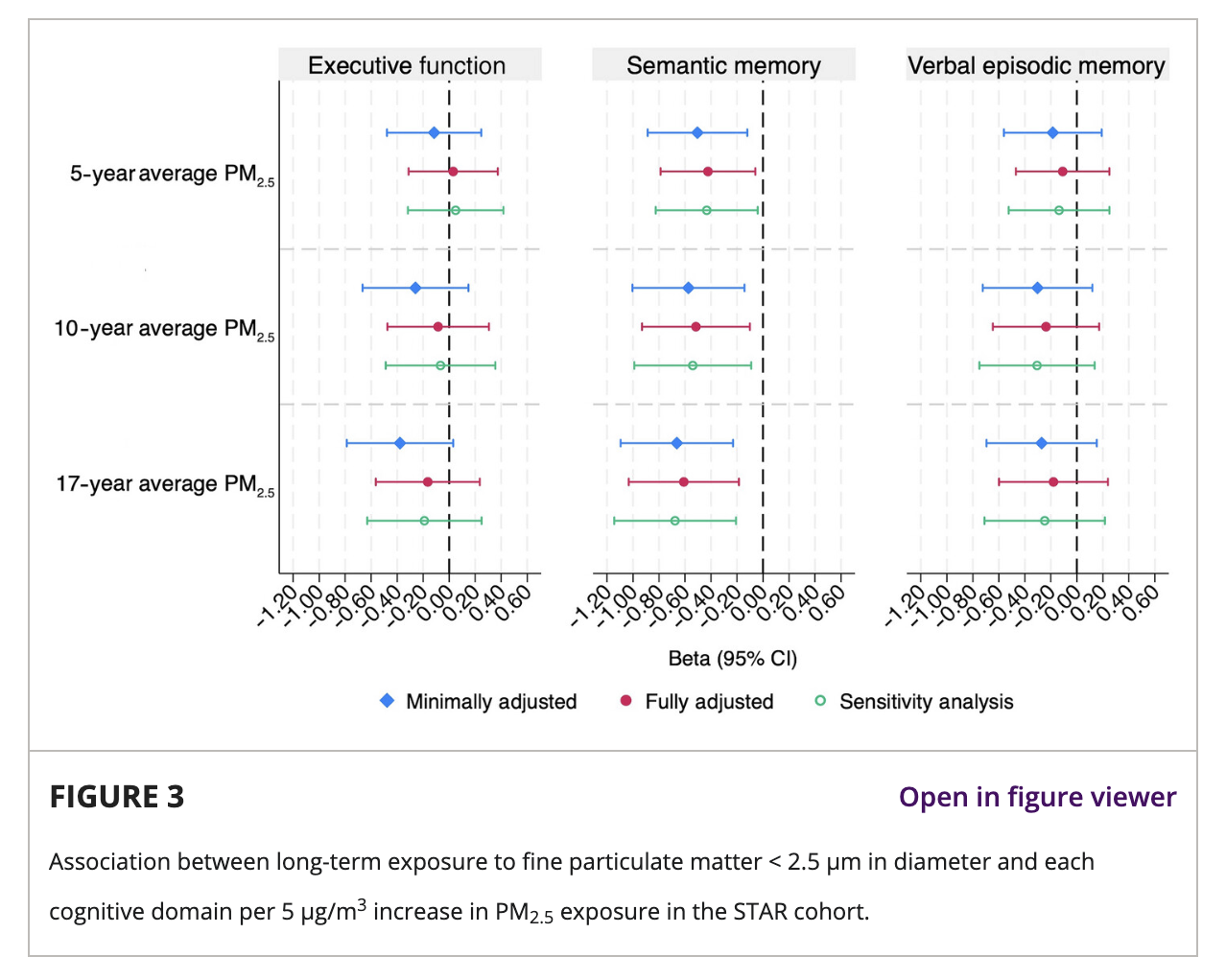
The study measured 3 specific areas of their cognitive ability — semantic memory (general accumulated knowledge), verbal episodic memory (ability to recall words and stories), and executive function (planning and multitasking). Daily air pollution data and each STAR participant’s home address was used to compute individual 5-year, 10-year, and 17-year average exposures to a type of fine particulate pollution called PM2.5.
Analyses found higher PM2.5 exposure levels over 17 years were associated with lower semantic memory. The decrease in semantic memory associated with a 5 microgram per cubic meter(µg/m³) increase in 17‑year average PM2.5 exposure was greater than what would be expected over a decade of aging, the researchers said. No association was seen between air particle pollution and executive function or verbal episodic memory.
“Looking at each cognitive domain separately is important, because different risk factors can affect each domain differently,” said Alexeeff. “Our study was designed to look for these specific nuances, and because we did not use a global measure of cognition, we were able to learn that long‑term air pollution exposure affects semantic memory but not other domains.”
Small particle pollution
Particle pollution is measured in microns; about 25,000 microns equal an inch. PM2.5 particles are 2.5 microns or less in size — about 30 times smaller than the width of a piece of hair. They are released in exhaust from cars, trucks, and other vehicles; from burning wood, heating oil, and coal; and by factories, power plants, and forest fires.
 Most research in this field has focused on the effect particle pollution has on the blood vessels and heart. A previous study led by Alexeeff showed that small particle pollution can increase risk of dying of heart disease and stroke. But small particles can also travel to the bloodstream and the brain. The new study adds to a growing body of research investigating the effect exposure to small particle pollution may have on cognitive function and risk of dementia.
Long-term exposure to air pollution has also been shown to cause greater harm to under-resourced communities. In addition, studies led by the U.S. Environmental Protection Agency have found that people who are Black, Latino, or Asian are more likely to live in areas with higher levels of particulate air pollution.
“This study is an important contribution to our understanding of the long-term impacts particle air pollution has on our health,” said Alexeeff. “Air pollution affects multiple systems in the body, and our findings suggest that exposures may continue to influence health more than a decade later.”
The study was funded by the National Institutes of Health.
Co-authors include Chinomnso N. Okorie, MS, and Ai-Lin Tsai, MS, of the Division of Research; Joel Schwartz, PhD, of the Harvard T.H. Chan School of Public Health; Amanda J. Goodrich, PhD, Rachel A. Whitmer, PhD, and Kathryn C. Conlon, PhD, of the University of California Davis School of Medicine; and Kelly Bakulski, PhD, and Scarlet Cockell, MPH, of the University of Michigan.
###
About the Kaiser Permanente Division of Research
The Kaiser Permanente Division of Research conducts, publishes, and disseminates epidemiologic and health services research to improve the health and medical care of Kaiser Permanente members and society at large. KPDOR seeks to understand the determinants of illness and well-being and to improve the quality and cost-effectiveness of health care. Currently, DOR’s 720-plus staff, including 73 research and staff scientists, are working on nearly 630 epidemiological and health services research projects. For more information, visit divisionofresearch.kp.org.






Comments (0)