

Kaiser Permanente study supports guidelines that offer option of maternal vaccine or vaccination of newborns
Two methods were similarly effective at preventing respiratory syncytial virus (RSV) infection or hospitalization during a baby’s first 6 months of life, according to a new study of thousands of infants born at Kaiser Permanente Northern California (KPNC). The study was presented at IDWeek and simultaneously published in JAMA Network Open.

“Under current U.S. guidelines, infants due during RSV season — October through March — are eligible for either approach, with neither preferred over the other,” said lead author Karen B. Jacobson, MD, MPH, an infectious disease physician and research scientist at the Vaccine Study Center at the Kaiser Permanente Division of Research. “We found that both approaches were comparably effective, supporting either as a reasonable option. Families and mothers can feel good about making the choice they feel is right for them.”
An infant is more likely to be hospitalized for RSV in their first year of life than for any other cause. Since 2023, parents of babies due in the fall or winter have had the option to have the mother vaccinated with RSVpreF late in pregnancy, which transfers protection to the fetus, or have the baby treated with nirsevimab, a preventive monoclonal antibody. Both are highly effective at preventing RSV infection and hospitalization. However, whether one is better than the other has been unclear.
To answer that question, the research team analyzed electronic health records of 17,533 infants born at KPNC in the 2 RSV seasons between 2023 and 2025. They also included data from the Division of Research’s Perinatal Obstetric Database, which links infants to their mothers.

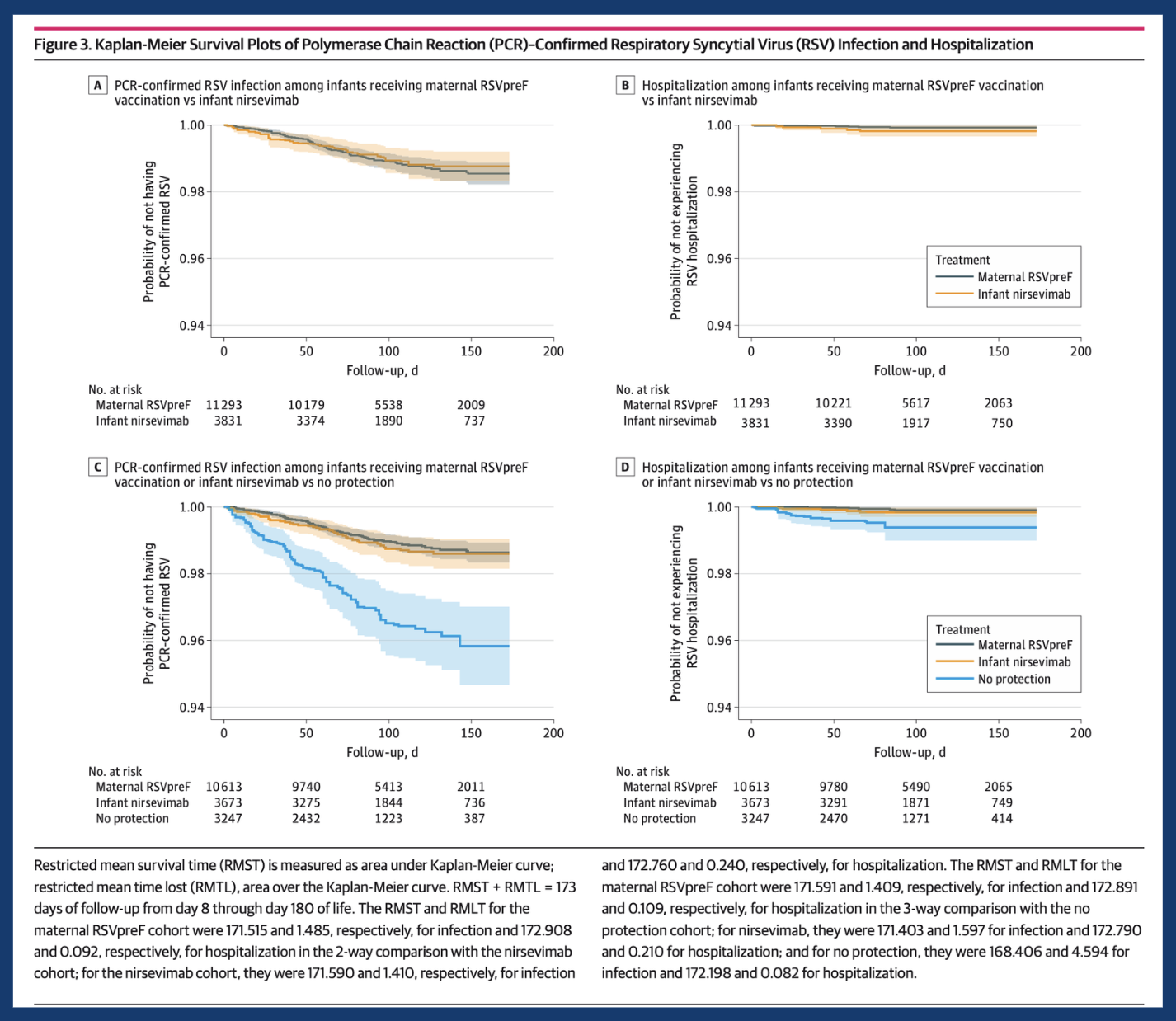
The study confirmed that nirsevimab and RSVpreF were both highly effective. It also found that neither method was significantly more effective than the other. Among the 11,294 infants whose mothers were vaccinated with RSVpreF, 106 (0.94%) became infected and 7 (0.06%) were hospitalized for RSV during their first 6 months of life. And among the 3,831 infants who received nirsevimab, 40 (1.04%) were infected and 5 (0.13%) hospitalized.
“The good news for parents is that they should be reassured and confident that both methods will protect their babies,” said senior author Nicola Klein, MD, PhD, a research scientist and the director of the Vaccine Study Center. “The important things are that our findings support the current guidelines and that parents have two different safe and effective options.”
Study design strengthens findings
The researchers used a statistical approach known as matched cohorts to strengthen the study’s findings. The technique allowed them to account for seasonal fluctuations in RSV infection risk by matching and comparing infants born in the same week. They were also able to group infants by characteristics such as sex, race, and ethnicity; mother’s age and underlying health conditions; and residential neighborhood. This meant within each matched group, the only known difference between the infants was whether the mother had RSVpreF, the baby was given nirsevimab, or neither mom nor baby were protected against RSV.
“By comparing RSVpreF to nirsevimab in groups of very similar infants born at the same time of year to very similar mothers at Kaiser Permanente, we could more clearly see if one was more effective,” explained Jacobson.
Two safe approaches
If given to a pregnant mother at least 2 weeks before birth, RSVpreF prompts production of antibodies that can transfer through the placenta to the fetus and protect against RSV after birth. Nirsevimab is a monoclonal antibody — not a vaccine — that delivers protective anti-RSV antibodies directly to the infant.
 Each approach has its potential pros and cons, Jacobson said. “If a mother is vaccinated, her baby is protected right from birth, with no delay,” she said. “But if she delivers too soon after being vaccinated, there might not be enough time for the antibodies to transfer to her baby. In that case, the baby may need to receive nirsevimab. Other mothers may wish to limit the number of vaccines they receive while pregnant and may prefer to have their baby receive the monoclonal antibody.”
The new study builds on the team’s previous research that showed babies born at KPNC had high rates of immunization against RSV.
Vaccine Study Center researchers will continue to assess the use and effectiveness of both immunization methods. The also hope to identify specific maternal or infant characteristics that might make one approach better for some mothers and babies than others, which could lead to more personalized recommendations.
“One of the areas we want to explore is whether mothers who are vaccinated continue to transfer antibodies to their infants through breastmilk,” said Jacobson, “If that’s the case, then it’s possible that babies who are breastfed benefit even more from the mother’s vaccination.”
The study was funded by the National Institute of Allergy and Infectious Diseases and the Division of Research.
Additional co-authors were Andrew Watson, MS, MA, Lauren Liao, PhD, Sally Stephens, MPH, Maqdooda Merchant, MSc, and Ousseny Zerbo, PhD, of the Division of Research.
###
About the Kaiser Permanente Division of Research
The Kaiser Permanente Division of Research conducts, publishes, and disseminates epidemiologic and health services research to improve the health and medical care of Kaiser Permanente members and society at large. KPDOR seeks to understand the determinants of illness and well-being and to improve the quality and cost-effectiveness of health care. Currently, DOR’s 720-plus staff, including 73 research and staff scientists, are working on nearly 630 epidemiological and health services research projects. For more information, visit divisionofresearch.kp.org.






Comments (0)