


Kaiser Permanente study identifies census tracts with vaccination coverage below herd immunity threshold
Some areas of Northern California have childhood vaccination rates for measles below the threshold to maintain herd immunity, according to a Kaiser Permanente study.

The study, published in JAMA Network Open, found census tracts in Northern California where measles vaccination of children is below 95%, the immunity threshold.
“California’s statewide measles vaccination coverage looks pretty high compared with other states,” said lead author Karen Jacobson, MD, MPH, a research scientist with the Kaiser Permanente Division of Research. “But our study found pockets of low vaccination coverage in Northern California. California is not immune from the risk of a measles outbreak.”
The researchers calculated the percentage of 7-year-old members of Kaiser Permanente Northern California who had received the measles, mumps and rubella (MMR) vaccines. The MMR vaccine is given in 2 doses; the first between 12 and 15 months of age and the second between ages 4 and 6.
To keep community transmission of measles under control, infectious disease officials recommend at least 95% of children receive the MMR vaccine. National figures from the Centers for Disease Control and Prevention (CDC) show 92% of American children were vaccinated against measles in 2025; the average was 96% in California. Those are declines in coverage since before the pandemic, when the national average was 95%.
Measles is highly contagious and can cause serious complications, particularly for babies and young children. Hospitalization rates are significant for unvaccinated people who get the disease. Measles can be fatal, particularly for young children who have respiratory or neurologic complications.

Vaccination is safe, effective, and offers lifelong protection, noted study senior author Nicola Klein, MD, PhD, who leads the Kaiser Permanente Vaccine Study Center. “Public health efforts to keep measles at bay have been successful up until the past couple of years,” she said. “It is very concerning to see the resurgence of this largely preventable disease in the U.S. It is important to identify the specific communities where doctors, nurses, and public health officials can provide families with information and support to get immunization rates back up to safe levels.”
A more granular view
The analysis found 248,048 7-year-old Kaiser Permanente members fully immunized against measles between 2017 and 2024. Across Northern California, measles vaccine coverage was 97.6%. There were 276 census tracts with coverage under 95%, including 24,303 children, or 9.8% of the total.
The analysis by census tract allows a more granular view of vaccine coverage than reports from the CDC by state or county. “Most counties in California have above-95% coverage which seems reassuring,” Jacobson said. “But that doesn’t always tell the whole story.”
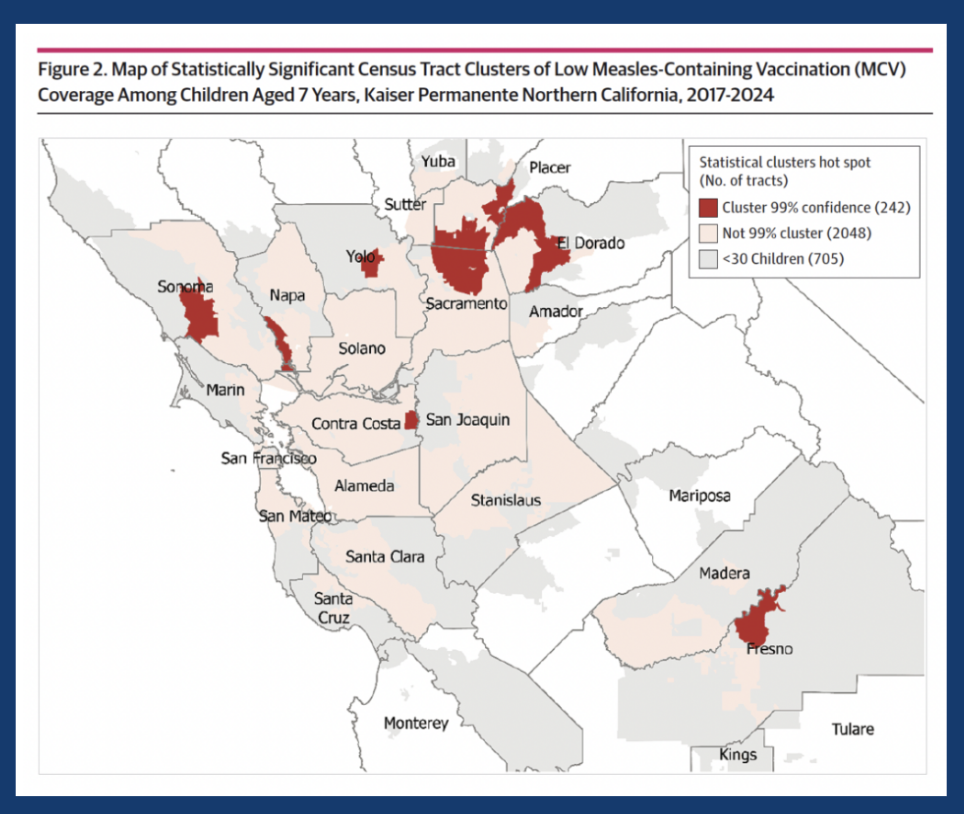 The study found coverage as low as 75% in some Northern California census tracts. It found 7 clusters of census tracts with significantly lower-than-expected coverage, located in the North San Francisco Bay area, Sacramento metropolitan area, and Fresno County.
“One main message of our study is to not be falsely reassured by state or county-level vaccination coverage data, because there could be geographic pockets where much less than 95% of children are vaccinated,” Jacobson said.
The researchers are sharing their findings with pediatricians within the health system so they can be aware of MMR vaccination rates in their communities. Local public health officials could also make use of the findings.
The study counted only Kaiser Permanente members, so it does not reflect the total population of 7-year-olds in Northern California. Kaiser Permanente covers about a third of the population of Northern California. Because the health system emphasizes childhood vaccination, Jacobson said, its members are more likely than the general community to be protected against measles.
As vaccination rates decline, there have been measles outbreaks in U.S. communities, most recently in Utah and Virginia. As of early July, CDC had counted 2,231 confirmed measles cases, close to the 2025 total of 2,288, which was the highest number in the U.S. since 1991. There have not been any U.S. deaths from measles so far in 2026; in 2025 3 people died.
The study was carried out by the Vaccine Safety Datalink, a project of the CDC, which uses real-world patient data from Kaiser Permanente and several other health systems across the country. The new study focused on only Northern California data.
The study was funded by the Centers for Disease Control and Prevention.
Additional co-authors were Kristin Goddard, MPH, Joan Bartlett, MPP, MPH, Sally C. Stephens, MPH, Helena Archer, PhD, MPH, Lauren D. Liao, PhD, and Ousseny Zerbo, PhD, of the Division of Research; Joshua T. B. Williams, MD, of Denver Health; Seohyun Kim, PhD, of the Mid-Atlantic Permanente Research Institute; and Sophia R. Newcomer, PhD, MPH, of the University of Montana.
###
About the Kaiser Permanente Division of Research
The Kaiser Permanente Division of Research conducts, publishes, and disseminates epidemiologic and health services research to improve the health and medical care of Kaiser Permanente members and society at large. KPDOR seeks to understand the determinants of illness and well-being and to improve the quality and cost-effectiveness of health care. Currently, DOR’s 720-plus staff, including 73 research and staff scientists, are working on nearly 630 epidemiological and health services research projects. For more information, visit divisionofresearch.kp.org.




Comments (0)