


Full-day event draws researchers and clinicians from Kaiser Permanente Northern California, Stanford, UC Davis, UC San Francisco, and Veterans Affairs
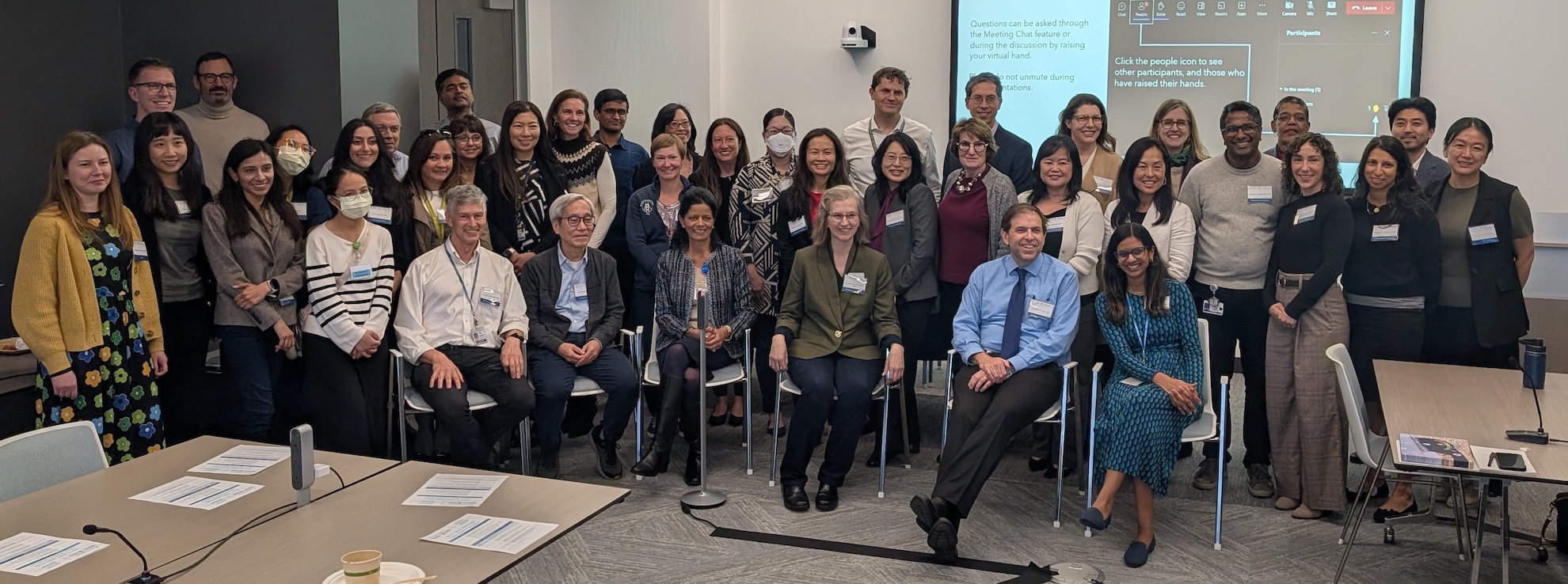
More than 100 researchers and clinicians took part in the 2025 Northern California Division of Research (DOR)/The Permanente Medical Group (TPMG) Cancer Research Symposium hosted by the DOR Cancer Section. Attendees represented service areas throughout Kaiser Permanente Northern California (KPNC) as well as Stanford, UC Davis, UC San Francisco, and the U.S. Department of Veterans Affairs.
 DOR Director Rachel Ramoni, DMD, ScD, kicked off the day by underscoring the potential impact the cross-disciplinary symposium could have on improving clinical care. “Our patients are counting on us,” said Ramoni. “We must focus on the driving question that unites us: How can we work together with external partners to increase our capacity to do research that benefits our members, communities, and humanity?” [Ramoni_Slides]
Theodore R. Levin, MD, the DOR associate director who leads the Cancer Section, and a TPMG gastroenterologist, followed, using his keynote address to highlight the innovative studies and research findings that have established DOR and TPMG as leaders in cancer research, patient care, and clinical trials. [Levin_Slides]
Survivorship and Screening
DOR research scientist Marilyn Kwan, PhD, moderated the first morning session, Survivorship and Lifestyle.
 Samantha Siegel, MD, director of Cancer Survivorship at KPNC in San Francisco, started the session, discussing how her own cancer diagnosis has informed her leadership of the KPNC PCP-ONC Program, which helps primary care providers and oncologists coordinate patient care.
Next, DOR Research Scientist Elizabeth Cespedes Feliciano, ScD, described her research on body composition and exercise, and what is needed to move the research in this field into personalized care. She was followed by DOR Research Scientist Lawrence Kushi, ScD, who closed out the panel with a review of the ways Kaiser Permanente resources are used to study cancer survivorship and outcomes. [Kushi_Slides]
DOR Research Scientist Vignesh Arasu, MD, PhD, moderated the second morning session, Cancer Screening and Surveillance. Thomas Urbania, MD, a TPMG radiologist, opened the session, discussing his recent research on surveillance of incidental pulmonary nodules. He was followed by Eleanor Ormsby, MD, a TPMG radiologist, who discussed the risk of pancreatic cancer in indeterminate pancreatic cysts. [Ormsby_Slides]
TPMG surgeon George Liao, MD, closed out the session describing his research evaluating the safety and efficacy of the current imaging guidelines for gallbladder polyps. [Liao_Slides]
Cancer surveillance
The presentations that followed showcased two screening studies currently taking place at KPNC. First, TPMG dermatologist David Lee, MD, discussed his research on KP-SUNTRAC, a skin cancer surveillance program for solid organ transplant recipients. [Lee_Slides]
Next, DOR Research Scientist Lori Sakoda, PhD, discussed KPNC’s contributions to the National Cancer Institute’s Cancer Screening Research Network Vanguard Study, a nationwide study evaluating multi-cancer detection blood tests.
Cancer treatment
DOR Research Scientist and TPMG oncologist Melisa Wong, MD, moderated the first afternoon session, Active Treatment. TPMG medical oncologist Andrea Harzstark, MD, discussed KPNC’s comprehensive approach to testicular cancer care. [Harzstark_Slides]
 She was followed by DOR Research Scientist and TPMG oncologist Meera Ragavan, MD, who discussed her research investigating ways to improve equity in clinical trial enrollment.
Next, DOR Research Scientist Candyce Kroenke, ScD, discussed her research that is investigating ways to identify and address the social needs of people with cancer.[Kroenke-Slides]
She was followed by Jacek Skarbinski, MD, director of the Delivery Science and Applied Research (DARE) program and TPMG infectious disease and HIV specialist, who discussed his research showing the importance of the COVID-19 vaccine booster for adults with cancer. [Skarbinski_Slides]
In her talk that followed, Smita Rouillard, MD, associate executive director at TPMG, praised the ongoing relationship between research and clinical care at KPNC. “Research is the engine of health care innovation and quality,” said Rouillard. [Rouillard_Slides]
Two panel discussions rounded out the Symposium.
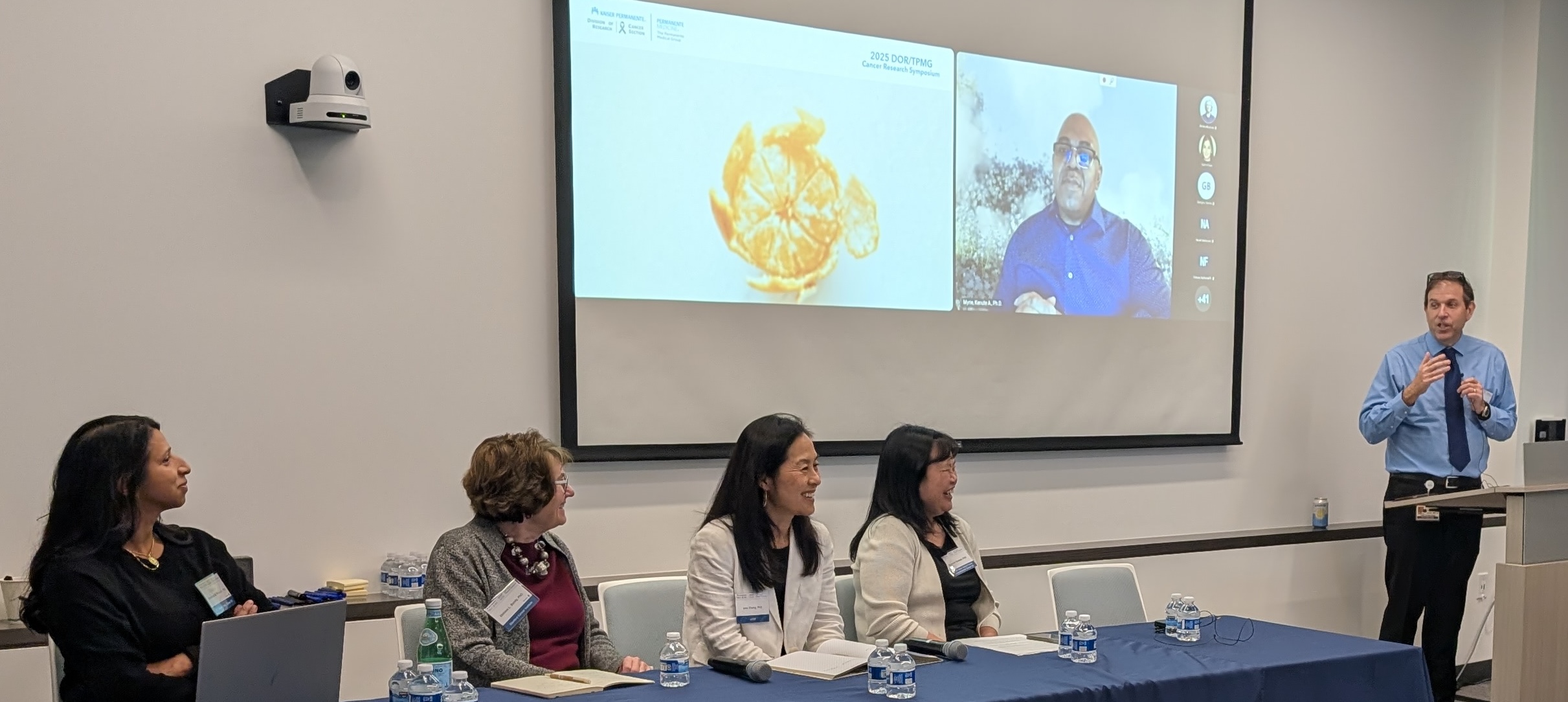 The first panel, moderated by Levin, included Scarlett Lin Gomez, PhD, co-leader of the UCSF Cancer Control Program; Shehnaz Hussain, PhD, associate director population sciences, UC Davis Comprehensive Cancer Center; Melissa Bondy, PhD, associate director population sciences, Stanford Cancer Institute; Iona Cheng, PhD, professor of epidemiology and biostatistics, UCSF; and Kenute Myrie, PhD, portfolio manager for oncology, U.S. Dept of Veterans Affairs. The panelists were asked to discuss potential areas of collaboration between DOR/TPMG and their centers and institutes.
The second panel discussion featured Raymond Liu, MD, chair of KPNC medical oncology and hematology, and Douglas Corley, MD, PhD, chief research officer for TPMG. Both encouraged TPMG physicians to get involved in the research opportunities available to them through DOR, DARE, and TPMG.
Watch a recording of the panel discussions.
“The symposium highlighted the breadth and depth of the cancer research we conduct,” said Levin. “The next step is to continue to initiate and build research relationships with the attendees from outside Kaiser Permanente. Because of the size of both KPNC and these potential collaborators, there is an opportunity to use our data to benefit the cancer care of people not only throughout Northern California, but across the U.S.”




Comments (0)